Wednesday, March 06, 2013

Assumption Corruption


A famous economics joke says it best: A physicist, a chemist and an economist are stranded on an island, with nothing to eat. A can of soup washes ashore. The physicist says, "Let’s smash the can open with a rock." The chemist says, "Let’s build a fire and heat the can first." The economist says, "Let’s assume that we have a can-opener..."

Though the above example is meant to be extreme, all economic models are based on underlying assumptions. They may pertain to variety of things such as the market structure, pricing mechanism, location, time lags, frictions, mathematical properties, etc., and they are used to simplify economic relationships.  An important assumption that drives many popular economic models is that of perfect information. In particular, models rely on the assumption that the prices of all goods and services are known.

As I was recently perusing the latest status updates of my Facebook friends, I noticed the following post: “How much do you pay a 14-year-old high school freshman as a mother’s helper a few days a week?”

As an economist, one might be inclined to quickly answer “whatever the market price is for that service!” However, it is clear from this post that that information is not actually known to the buyer.

While the internet has clearly helped to alleviate this information gap, it can still take time to gather all the relevant information necessary to make an informed decision. Sometimes, the cost of obtaining this information becomes so high that consumers decide not to research at all. For example, if you want to buy a hair dryer, a quick internet search may result in the same model offered at different stores for different prices, so you still wouldn’t know the relevant price for your needs without more digging.  

Even though the famous supply and demand model does not completely reflect the real world (since it assumes, among other things, that prices are known), this is not meant to imply that economic models are worthless. It would be impossible to model every detail of the “real world”; rather, it's important to make sure the assumptions are appropriate for what you are trying to analyze. For example, if you’re trying to model the effects of an increase in fuel price on consumers’ demand for SUVs, assuming perfect information for prices does not invalidate the results that it will decrease the demand for this good; it merely simplifies the model into something tractable. But in general, you’ll want to ask yourself the following questions when you examine an economic model: Are the assumptions of this model reasonable? Would changing the assumptions affect the result in a drastic way?

In short, be careful not to become a victim of assumption corruption, but don’t let fear of assumptions keep you away from using models at all either!

Discussion Questions

1. Another popular assumption is that agents act rationally and are utility-maximizers. How can this assumption still be valid in the presence of people volunteering their time or donating money?

2. Consider some other assumptions for the supply and demand model, such as price-taking behavior or the competitive hypothesis. How would relaxing those assumptions change the results of the model, if at all?

3. Why do we study economic models that don’t perfectly match our experience in the real world?

4. What are some other markets where the assumption of perfect information does not hold true in the real world?

Labels: , , , , , , ,

Tuesday, March 20, 2012

Kicking through the Ceiling


In the sports world, it has become cliché for people to say that every second counts. However, we expect that phrase to apply on the field, not to the teams trying to get there. Recently, a friend of mine wanted to register his team for a local kickball league. The registration was online only, starting at noon. He had a problem with his credit card that slowed him down, and by 12:02, all the spots in the league were taken and his team was shut out.

Rather than seeing his misfortune as a sign of kickball’s growing popularity, or the quick typing skills of other kickball managers, the first thing that came to my mind was that the market for league entries must be distorted. The league uses public fields that also need to accommodate other sports and high schools, so time on the fields is limited. Since the kickball league will only have a fixed number of hours on the fields, and since the season needs to accommodate a set number of games, it’s fair to think about the supply of league space as fixed, or perfectly inelastic. Most importantly, even at very high market prices, there is no way to add additional teams to the league.

If limited space were the only constraint on the market, then we could find the equilibrium for the market at the intersection of supply and demand, and thus know the equilibrium price where there are exactly as many teams willing to pay as there are spaces in the league. However, since the league filled up so fast, and teams (like my friend’s) that are willing to pay more than the $500 entry fee are unable to join, it appears that there is an artificial price ceiling in this market. Since the league is publicly run, it is likely that someone decided on a “fair” price to charge, so that entries in the league would be open to people of varying incomes. Unfortunately, price ceilings create shortages, that is, they force some people who desperately want the good to go without it. When goods do not sell for the unrestricted equilibrium price, people who value the entries the most do not necessarily receive them. Thus, the shortage caused by a binding price ceiling will end up lowering society’s total welfare.

Can economic theory suggest a solution that would still offer entries at the “fair” price, but also make sure the entries go to the teams that value them the most? Suppose that the league entries were still given out the same way, but once initially purchased by a team manager, an entry could be resold to a team that did not sign up fast enough, if both parties agree. Teams that got entries and value them at least as much as the equilibrium price will hold on to their entries, but teams that were too slow to purchase them initially will be able to buy them from teams who value them less than the equilibrium price. In terms of the final price and quantity of entries, making the league entries tradable will achieve the same result as removing the price ceiling altogether: the market price for the tradable entries will rise to the unrestricted equilibrium price, and the teams that value them the most will end up in the league. However, setting a lower price initially allows some teams the opportunity to buy that otherwise wouldn’t be able to get them. Society’s total welfare is maximized by either making the entries tradable or removing the price ceiling, the only difference is who earns the surplus. As you can see, there are different ways to maximize society’s welfare. Some can be more complicated than others, but they can accommodate different concerns about fairness.

DISCUSSION QUESTIONS:

1) Currently, the market mechanism used to allocate kickball league entries is first-come-first-served. What behaviors does this sort of mechanism encourage?

2) If league entries are tradable and originally given on a first-come-first-served basis, who would attempt to get the initial entries? Is there a chance people who do not want to have a kickball team might apply for a slot? Under a tradable permit system, does the way the entries are initially allocated affect who receives the most welfare?

3) The Coase Theorem is a public economics result that applies to markets where governments want to reduce pollution. It says that the most efficient way to reduce pollution to any desired level is to give firms in an industry permits to pollute the desired amount, and then allow the firms to trade the permits. Consider the similarities between a fixed number of kickball league entries and a fixed amount of pollution by an industry. What results would you expect to see in the market for pollution permits? What effect would creating that market have on society’s welfare?

Labels: , , ,

Tuesday, April 14, 2009

ARRGGHH... The Stakes Be High, Says I!


When you pay ransom to a hostage-taking pirate, traditional economic theory suggests that you increase the returns to piracy, encouraging more of it. If you kill a hostage-taking pirate, you increase the cost of piracy, which should discourage would-be pirates from taking to the seas.

The response by the Somali pirates to the U.S. Navy's recent killing of three pirates has been just the opposite though. These gangs say they are now devoted to revenge-taking over more ships and taking more hostages than ever. The cost of doing business has risen, and yet they want to do more of this business than ever. Why do you think this is?

Discussion Questions

1. In order to quickly obtain large ransoms, pirates must signal a credible threat to cargo ship owners. How might this credibility issue play into the pirates' response to the actions of the U.S. government?

2. The pirates killed by U.S. Navy snipers were holding an American captain of an American boat with an American crew. Might governments respond differently in situations involving multi-national crews?

3. The pirates who were killed were likely just henchmen with little power in the criminal organization. Did the "cost of doing business" really rise very much for the pirates running the organization?

4. In what ways does the government provision of naval security in international waters resemble a public good? Might the current allocation of security (both private and public) in international waters be inefficiently low?

5. From the standpoint of ransom maximization for a small individual gang of pirates, what is the optimal amount of piracy? What is the ransom maximizing strategy if the piracy off the Somali coast is coordinated by a cartel of gang lords?

Labels: , , , , , ,

Monday, October 15, 2007

The 2007 Nobel Prize: Mechanism What?


The 2007 Nobel Prize in Economics went to Leonid Hurwicz, Roger Myerson, and Eric Maskin for “having laid the foundations of mechanism design theory.”

Mechanism design isn’t covered in the typical introductory economics class. The narrative of your first econ class usually goes something like this: “The ‘invisible hand’ of the free market is the most efficient way of answering the fundamental economic questions: what to produce, how to produce it, and who consumes it. Sometimes the market doesn’t work—for example, in the case of externalities or public goods.”

In short, a single mechanism—the “market”—is usually the topic of discussion for intro courses. But there are lots of other mechanisms for answering these fundamental questions. And unlike the market, which is a decentralized mechanism (meaning it is not run by a central authority), there are plenty of man-made institutions that are centralized mechanisms. One example of such a mechanism is an auction, which allocates goods according to bids. Another is a political election, which allocates political power according to the preferences of the electorate. Both auctions and elections have rules, and these rules determine the optimal behavior of bidders and politicians.

One of the biggest challenges of designing an economic mechanism is that people have private information about their own preferences. One of the most famous examples of a mechanism design problem is the provision of public goods. Suppose a small town is considering the establishment of a public park in the town square. Should it ask the citizens how much each of them would value the park, and ask them to contribute that amount? Clearly, each of the citizens would have an incentive to “free ride” on their neighbors by understating their own value of the public good—so as a mechanism, just asking for voluntary contributions leaves a lot to be desired.

We will be creating a news analysis assignment about mechanism design for professors who use Aplia in their classrooms. In the meantime, here are some discussion questions to get the ball rolling.

Discussion Questions

1. “Market failure” often occurs when dealing with things other than purely private goods—for example, public goods, common resources, or goods with externalities. One solution to market failure can be broadly categorized as “market solutions.” An example of such a market solution is the levying of a Pigovian tax, which keeps the basic mechanism of the market but alters the incentives of participants. Another solution to market failure would be to replace the market with another institution entirely. For example, the right to use a specific frequency of the wireless spectrum is allocated by the Federal Communications Commission using an auction mechanism. Can you think of other examples of market failure that we address by using centralized mechanisms? What are the advantages and disadvantages to centralized mechanisms as opposed to market solutions?

2. The term “asymmetric information” refers to cases in which parties hold private (or hidden) information about their preferences or costs. One of the core challenges of mechanism design is to encourage people to reveal their private information in a truthful and credible way. For example, it is easy to show that the optimal strategy for a bidder in a Vickrey auction like eBay is to bid one’s true value. Think of a situation in which asymmetric information causes problems. What kind of mechanism could you design to elicit truthful information from the participants in that situation?

3. A recent Washington Post article has provoked a fair amount of discussion about the effectiveness of torture in acquiring information from prisoners. The most heavily quoted passage of the article reads:

“We got more information out of a German general with a game of chess or Ping-Pong than they do today, with their torture,” said Henry Kolm, 90, an MIT physicist who had been assigned to play chess in Germany with Hitler’s deputy, Rudolf Hess.
What do you think the economic study of mechanism design would have to say about torture? Is it an effective method for eliciting private information? How would an economist interrogate a suspected terrorist?

Labels: , , , , ,

Tuesday, December 05, 2006

PlayStation 3 and Arbitrage


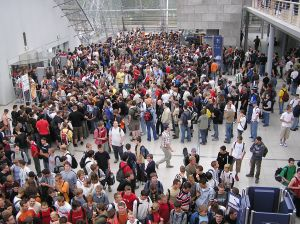
Two weeks ago, thousands stood in line to be among the first to get their hands on the PlayStation 3. Surprisingly, many of these people who waited through the cold, rain, and snow did not actually want to keep the PS3. They wanted to buy it for $600 and sell it on eBay for twice the price--a profit-seeking behavior known as arbitrage.

Economists define arbitrage as the act of profiting without bearing any risk. A large shortage is the best indicator of an arbitrage opportunity. A shortage occurs when quantity demanded exceeds quantity supplied--in other words, when the number of PS3's that consumers are willing and able to buy at the current retail price exceeds the number of PS3's available in stores. A shortage implies that there are consumers willing to pay more than $600 for a PS3 who were unable to purchase one because they were too busy to stand in line or too far back in the line. Arbitrage is a means to allocate the PS3's from the initial buyers to the people who want them even more than the original buyers.

Discussion Questions

1. Sony should have forecasted the shortages and price bids on eBay for the PS3 because they sold out of other popular consoles when they were first released (PlayStation, PS2, and PSP). Would it be profitable for Sony to eliminate the "frenzy shortages" by pricing high during the first months and lowering prices afterwards? For example, they could charge $1,000 for the PS3 in November and December, but lower it to $600 afterwards.

2. Sony reports that it costs more than $600 to produce a PS3. Why would it be profitable for Sony to sell the PS3 at an initial loss?

3. Why would a gamer prefer to pay $1,200 for a PS3 on eBay rather than standing in line to buy one for $600?

Labels: , , ,