

Finally Something Positive from the Cubs!
by Ben Resnick
the longest championship drought in the four major US sports, not giving their fans a World Series victory since 1908. But for as much heartache and disappointment the team has given its fans over the years, it also offers the local community something uniquely positive; what economists call a positive externality.
The Cubs have played their home games in Wrigley Field since 1916, two years after the iconic ballpark was built. The stadium sits right across the street from apartment buildings that rise above the outfield bleachers. Residents high enough up in the buildings or people on the roof can see into the ballpark and watch the game as it’s being played. That unique view of the ballpark action led some entrepreneurial building owners to put bleachers on their roofs and sell tickets.
Economically, the good the Cubs produce (the entertainment provided from watching baseball games) is non-excludable because the private firm (the Cubs) cannot prevent some people from consuming the good without paying. When people other than the consumers that purchase any good, gain something from the good’s production, economists call that a positive externality.
Firms that produce goods that give positive externalities do not receive the full economic reward associated with producing the good because they are not paid by everyone who uses it. Those firms can increase profits if they can find a way to make their good excludable and thus, deny the “free” use of their good.
As of the start of this season, it appears the Cubs might be trying to do just that. As a part of a planned stadium renovation, the Cubs have proposed building a large scoreboard that will block the views from neighboring rooftops. Aside from increased advertising that the new scoreboard would bring, it should also help to make their good scarcer and increase demand for tickets, driving prices up.
Where does the story go from here? The team hopes to begin construction this fall, but owners of neighboring buildings have threatened legal action, saying a new scoreboard will “drive them out of business” though it’s possible that an agreement which benefits all the firms involved can be reached (either privately or with the help of local government) before the issue goes to court.
Discussion Questions
Suppose that the Cubs could determine the number of home games they play based solely on attendance, rather than by a schedule set by Major League Baseball.
Suppose that the Cubs could determine the number of home games they play based solely on attendance, rather than by a schedule set by Major League Baseball.
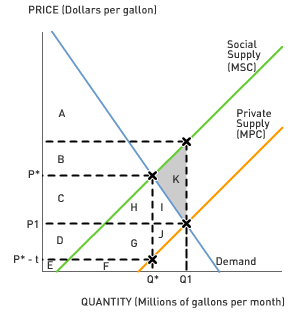
1. In this scenario, if the team does not get paid when people watch the game from rooftop seats, will the number of games played be socially optimal? What if the team does collect money from rooftop viewers? Explain why.
2. When the outcome is not optimal, will there be too many games played or too few?
3. Propose a policy that the local government could implement to fix the inefficiency and get the team to produce the socially optimal number of games.
4. Economists say a good is rivalrous if one person’s consumption of the good prevents another person from enjoying it. For example, you and I cannot eat the same hamburger. Would you consider the good the Cubs produce to be rivalrous? Does the way a fan sees the game influence your answer?
Labels: Baseball, Excludable Goods, Externalities
3:26 PM | Permalink | Comments |
Assign Aplia Reading


 Since it is generally easy to compare the price-tag cost of one good or service against another, people tend to consider only the monetary cost of a decision. However, what’s also important to consider is the whole value of what you are giving up when you make a decision. In economics, this is known as the opportunity cost. A simple textbook example describes a market that offers two goods for sale: apples and oranges. If an apple can be bought for $1 and an orange for $0.50, the monetary cost of buying an apple is $1, but the opportunity cost is equal to how much you value the two oranges that you give up if you choose to buy an apple. While this observation may not seem particularly important in this context, it can be applied far beyond the realm of monetary dealings.
 A millionaire in Switzerland was recently fined a world-record $290,000 for
  As a recurring Winter Olympics viewer, I am counting down the days until the games begin on February 12. As an economist, however, I am intrigued by the number of tools an introductory economics course provides students with to analyze the effects of the Olympic games on the local economy of Vancouver. Three topics in particular come to mind that most students will encounter in a basic economics course: consumer spending, negative externalities, and cost-benefit analysis.
 With significant contributions and analysis from Kasie R. Jean.


 In an important scene from the 1999 movie American Beauty, two characters—Jane and Ricky—watch
 It’s 85 degrees and sunny on this October day in the Bay Area, and this morning’s review of the






 Subscribe to this blog