Friday, January 13, 2012

A Penny Saved Is...


Which scenario would you prefer: (a) losing $30, or (b) losing $30, then losing $90, then regaining the original lost $30? While in most circumstances the first option is the unquestionably preferable, I recently found myself in a situation favoring the latter.

As a member of the Marin Sun Farms “meat club CSA” (community supported agriculture), I order a custom package of meats from a local farm that is delivered (frozen) once a month to a pick-up location near my home. While this arrangement offers me an excellent supply of local meat at a discounted price, the difficulty is remembering the monthly pick-up time. As disclaimed on the Marin Sun Farms website, “Packages not picked up promptly will be forfeited.”

This past Sunday I was sifting through emails when I discovered buried amongst online coupon offerings, eStatements, and a “Hello!” from mom, a reminder email sent the previous Thursday: “Pick up your CSA box today!” My heart sank as I pictured my box of grass-fed beef, lamb, and chicken slowly defrosting, decomposing, and ultimately being discarded. It had been a small shipment, only $30 worth, but nonetheless, I cringed at the waste.

Monday morning I awoke to another minor financial misfortune: a $90 parking ticket proclaiming my violation of section VC22500E – DRIVEWAY BLOCKING. D’oh! I knew when I parked that the rear of my car extended a few inches beyond the curb and into the neighboring driveway, but after half an hour searching for a spot I decided to take my chances (always thinking in economic terms, I figured that the expected cost of a ticket—equal to the true cost times the probability of actually receiving a ticket—was outweighed by the benefit from no longer looking for parking).

Chagrined by my back-to-back oversights, I called the number of the CSA pick-up location, just in case. To my surprise and relief, the woman in charge had managed to store my meat—not their usual policy—and I picked it up later that day.

By Monday night I had experienced the aforementioned $30 (perceived) loss, $90 loss, and $30 (perceived) gain, yet I felt better than I had felt on Sunday night when then I perceived only the $30 loss of meat. This may have had something to do with the order of events (after internalizing the loss of the ticket in the morning, the gain of $30 remained more salient at the end of the day), but I think it had more to do with how I perceived the true value of each loss. To a meat-loving economist, a discarded order constitutes a clear waste of resources—$30 of value—gone. The $90 parking ticket, on the other hand, represents a transfer of resources from me to the city of San Francisco, which ostensibly will put the money to use in the creation or maintenance of the public services I enjoy.

In introductory economics, we make a similar distinction between the deadweight loss and government revenue generated by taxes. Deadweight loss reflects the decrease in benefits to society (producers and consumers) resulting from fewer total transactions taking place. Economists view this loss to consumers and producers as different from the revenues a tax generates. Although both come at the direct expense of consumers and producers, the latter provides governments with the means to furnish public goods and services which indirectly benefit consumers, while the former—like rotten meat—is just no good.


Discussion Questions:

1. Why else might the $90 parking ticket be less painful than losing the meat shipment? Think about the “value” I got from time saved by parking illegally.

2. How does risk aversion factor into the decision of whether it’s worth taking the chance of doing something illegal? Consider a person who frequently speeds and occasionally gets speeding tickets. Ignoring the potential effects on others, might this too be a rational decision?

3. Consider other instances in which financial losses of the same dollar value might be felt in different ways (e.g. forgetting to take a $20 bill out of your pocket before washing it versus accidentally leaving an extra $20 as a tip on a restaurant bill?)

Labels: , , , , ,

Wednesday, April 15, 2009

The Price Is Wrong, Bob!


With significant contributions and analysis from Ben Resnick

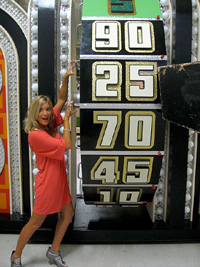
The Price Is Right, one of America’s favorite game shows, can be used to illustrate numerous economic concepts, including optimal bidding strategies, risk preference, and search theory. Twice an episode, one of the most purely mathematical portions of the show occurs, when contestants take their turn to spin "the big wheel." In addition to being a crucial prelude to the Showcase Showdown, it is a convenient hands-on application of using probability theory to derive an optimal decision-making rule. The wheel contains 20 equally sized panels corresponding to values between $0.05 and $1.00. Three contestants reach the wheel during each half of the show. The winning contestant is the one whose total score comes closest to a dollar without going over; as a prize, they earn one of the two spots in the show’s final round, the Showcase Showdown. One at a time, each contestant spins the wheel to get an initial value. The player then has the option to keep his current value or spin one more time. If he spins again, his final score is the sum of his two spins. Any contestant that goes over $1.00 automatically loses. In the event that two or three contestants are tied with the same final value, they each spin the wheel once, highest score winning.

Consider three contestants: Mr. 1 will spin first, Ms. 2 will spin second, and Mrs. 3 will spin last. Assuming that all of the contestants aim to maximize their chances of winning a spot in the Showcase Showdown, we set out to derive the optimal strategy for Mr. 1. In order to determine his optimal strategy, we will make three simplifying assumptions. First, each result from spinning the wheel is an independently determined random outcome, where each panel is equally likely to be spun. Next, in the event of ties, each tied player has an equal chance of winning (either 50% for a two-person tie or 33% for a three-person tie). Finally, the show pays a $1,000 bonus prize (and a chance to earn even more money on a “bonus spin”) to any contestant scoring exactly $1.00 on one spin or a combination of two spins. However, we will not consider these cash prizes as an extra incentive to spin again since they have no bearing on which contestant goes to the Showcase Showdown. We focus only on the decision-making rule that gives Mr. 1 the best chance to make the final round.

The only decision a player makes during the game is whether to spin again or stop after the first. Clearly this decision will depend on the value of the first spin—the higher the first spin, the more reasonable it is to stop. To explain fully how a player maximizes his chance of reaching the Showcase Showdown, we solved for a cutoff value: the lowest initial spin value where Mr. 1 has a higher probability of winning by staying rather than spinning again. In order to find the optimal stopping value for Mr. 1, we first calculated the probability that Mr. 1 wins the game (either outright or through the tie-breaker) if he stays with any initial spin. This gives 20 different probabilities of winning the game if Mr. 1 stays, one for each possible spin value. For example, if Mr. 1 stops with $0.55, he stands a 7.4% chance of winning whereas if he stops with $1.00, he has an 86.2% of going to the Showcase Showdown. Next, we calculated the odds that Mr. 1 wins if he spins again. To do this, we looked at his likelihood of winning for each possible score after his second spin is added to his first. Mr. 1’s optimal cutoff in this game is $0.70, where stopping with a spin of $0.70 gives a 19.8% chance of winning, but spinning again gives only a 15.8% chance of winning. At any initial spin less than $0.70, Mr. 1 has a better chance of winning by spinning again. For example, after a first spin of $0.65, Mr. 1 has a 14.6% chance of winning if he stops and a 16.8% chance of winning by spinning again. By a similar method, we find that in the case where Mr. 1 goes over $1.00, the stopping rule that maximizes Ms. 2’s chances of winning is to stop with any initial spin of $0.55 or more.

Discussion Questions

1. How would you expect the stopping values to change if a fourth player were added to this game? What would the effect on the stopping values be if we factor in the bonus prize for a total score of exactly $1.00?

2. Given that the stopping values decrease as fewer players remain in the game, do you expect a player with a certain spot in the order to have an advantage? If so, which one?

3. Deal or No Deal is an example of another game show where a contestant’s optimal strategy could be described by a stopping rule. Can you think of other games where this type of strategy can be applied?

Labels: , ,